

Written by Francesca Steyn, NMC-registered fertility practitioner
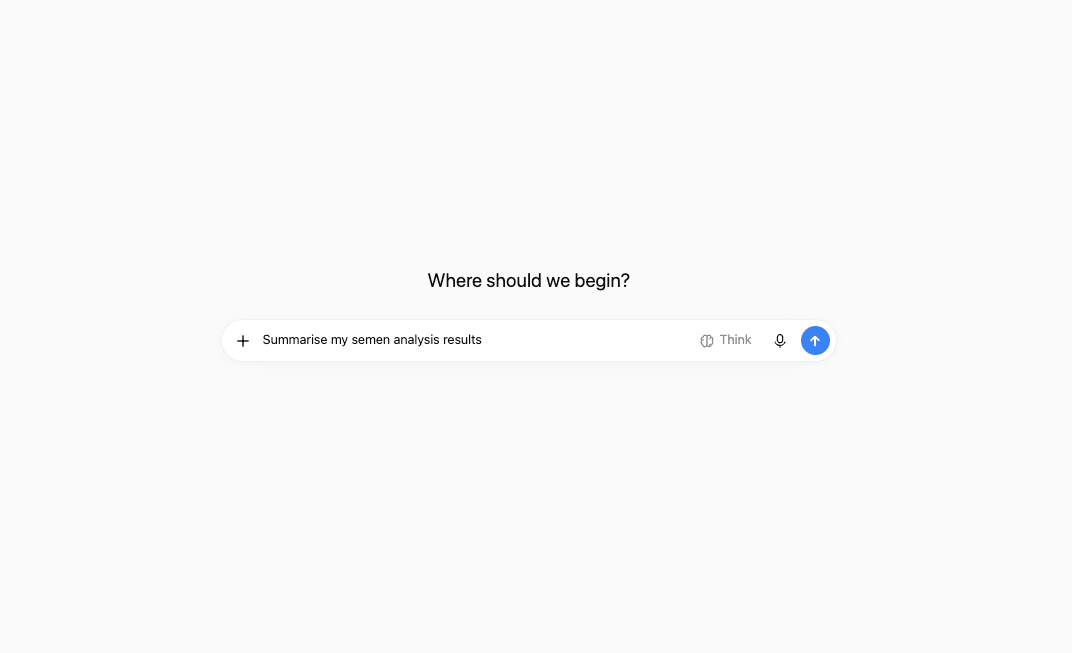
AI chatbots like Claude and ChatGPT can help you make sense of a results report, but they can also get it wrong in ways that are hard to spot. That is why any clinical result, including a semen analysis, should be reviewed by a qualified specialist before you draw conclusions from it.
It makes sense that people turn to AI. Results often arrive as a page of numbers, abbreviations and reference ranges. Waiting days for an appointment to have them explained can feel like forever, and a chatbot answers in seconds, at any hour, without judgement.
Used well, these tools can help you prepare questions and understand terminology. Used as a replacement for expert review, they can leave you falsely reassured or needlessly anxious. This post explains why, and how to get the best of both.
How AI chatbots actually work
Claude and ChatGPT are large language models. They generate answers by predicting likely words based on patterns in the text they were trained on. They do not examine your sample, check your medical history or confirm that what they say is current.
That matters for clinical results in three ways. First, the model's knowledge stops at a training cutoff, so anything published after that date may be missing. Second, it only knows what you type in, so missing context goes unnoticed. Third, it is designed to sound fluent and helpful, which means a wrong answer can read just as confidently as a right one.

Five ways AI can misread your results
1. Quoting guidance that has been replaced
Clinical guidance changes, and AI does not always keep up. We have seen Claude refer to out-of-date NICE (National Institute for Health and Care Excellence) guidance on fertility. For more than a decade, NICE's fertility guideline was CG156, first published in 2013. In 2026 it was updated and replaced by NG257. A chatbot that still points you to CG156 may describe assessment pathways that no longer reflect current NHS practice.
The same risk applies to semen analysis. The WHO (World Health Organisation) laboratory manual moved to its sixth edition in 2021, and older editions used different reference values. An AI drawing on older sources can compare your results against the wrong benchmark.
2. Ignoring your lab's own reference ranges
Reference ranges vary between laboratories, methods and populations. A chatbot will often fall back on a generic range it has seen online rather than the one printed on your report. A result can look "low" to AI and be entirely normal for the lab that measured it.
3. Reading one number in isolation
A semen analysis is a set of related measures: volume, concentration, motility and morphology. Hormone results work the same way. Specialists read them together, alongside your age, health history and how the sample was collected. AI tends to comment on each value separately, missing the pattern that actually matters.
4. Filling gaps with confident guesses
When a model lacks information, it rarely says "I don't know". It fills the gap with something plausible. This is sometimes called hallucination: an invented statistic, a misremembered threshold or a reference to a study that does not exist.
5. Telling you what you want to hear
Chatbots are built to be agreeable. Ask a leading question such as "this looks fine, right?" and you are more likely to get reassurance. Ask the same question with worry in your voice and you may get the opposite. Small changes in wording can produce very different answers.
What the research says
AI can score well on tests, but real people using it get far weaker results. A randomised study of 1,298 UK adults, published in Nature Medicine in 2026, tested GPT-4o and two other models on medical scenarios. On their own, the models identified the relevant condition 94.9% of the time. When members of the public used the same models, they identified it in fewer than 34.5% of cases, and did no better than people using ordinary sources such as internet search.
The Oxford researchers behind the study found that people did not know what information the chatbot needed, that slight changes in a question produced very different answers, and that responses mixed accurate and inaccurate advice. Dr Rebecca Payne, one of the authors, put it plainly: "AI just isn't ready to take on the role of the physician."
Other research points the same way. A 2026 npj Digital Medicine study of 10,000 health check-up cases found that leading models, Claude and GPT-4o among them, handled simple markers like glucose and cholesterol almost perfectly. Accuracy dropped for results that needed several values weighed together, such as blood pressure, and the researchers found biases linked to age and sex. That is exactly the kind of joined-up judgement a semen analysis or hormone profile requires.
Why specialist review matters
A specialist does more than read numbers. They interpret your results in the context of your life, and they are accountable for what they tell you. No chatbot offers either.
They work to current standards. Specialists follow up-to-date guidance from NICE and the WHO as part of their professional practice. When guidance changes, as it did with NG257, their advice changes with it.
They see the whole picture. A fertility specialist considers how your sample was collected, your age, any medication, recent illness and how long you have been trying to conceive. One raised temperature from a bout of flu can affect sperm for around three months. A chatbot will not know to ask.
They know when to repeat a test. Semen quality naturally varies from one sample to the next. A specialist can tell you whether a result is worth acting on or worth retesting, rather than leaving you to guess.
They can ask you questions. A good consultation is a conversation. A specialist spots what is missing and asks about it. AI answers only what it is asked.
They are regulated and accountable. In the UK, laboratory clinicians are registered with the HCPC (Health and Care Professions Council) and nurses with the NMC (Nursing and Midwifery Council). Both follow professional codes of conduct. A chatbot has no registration, no duty of care and no one to answer to if it gets things wrong.
They support you through what comes next. Fertility results can carry real emotional weight. A specialist can explain what a result means for you, talk through your options, and refer you on when needed. That human support is part of the care, not an extra.
At Malebox Health, every semen analysis is carried out by HCPC registered clinicians following WHO guidelines. Your results are then explained in a video consultation with an NMC registered fertility nurse, so you never have to interpret them alone.
How to use AI sensibly alongside a specialist
AI works best as a way to prepare for a conversation with an expert, not as a stand-in for one. If you do use it, a few habits help:
- Use it to learn the language. Asking what "motility" or "morphology" means is a good use. Asking whether you are fertile is not.
- Prepare your questions. Ask AI to help you list questions for your consultation, then take them to the specialist.
- Check the source and the date. If a chatbot quotes guidance, ask which version and when it was published. Then check it yourself on the NICE or NHS website.
- Use your lab's reference ranges. Your report's ranges come first. Treat any generic range from AI with caution.
- Protect your privacy. Think carefully before pasting personal health information into a chatbot.
- Never act on AI alone. Do not change medication, delay care or make treatment decisions based on a chatbot's reading of your results.
The bottom line
AI is a useful starting point, but your results deserve a specialist. Chatbots can explain terms and help you prepare, yet they can quote outdated guidance, miss context and sound certain when they are not. A qualified professional reads your results against current standards, in the context of your life, and helps you take the next steps with confidence.
Frequently asked questions
Can ChatGPT or Claude interpret my sperm test results?
They can explain what the terms on your report mean. They cannot reliably tell you what your results mean for you, because they lack your history, your lab's methods and up-to-date clinical judgement.
Is AI medical information up to date?
Not always. Each model has a training cutoff, and guidance changes. For example, NICE replaced its fertility guideline CG156 with NG257 in 2026, and a chatbot may still refer to the older version.
Why do AI chatbots give different answers to the same question?
They generate responses based on probability and the exact wording you use. Small changes in phrasing can lead to noticeably different answers.
Who should review my semen analysis?
A qualified specialist. With Malebox Health, samples are analysed by HCPC registered clinicians and results are explained in a video consultation with an NMC registered fertility nurse.
Sources
- NICE. Fertility problems: assessment and treatment (CG156), replaced by NG257
- Bean AM et al. Reliability of LLMs as medical assistants for the general public: a randomized preregistered study. Nature Medicine, 2026.
- University of Oxford. New study warns of risks in AI chatbots giving medical advice. 10 February 2026.
- Large language models for interpretation of health checkup results. npj Digital Medicine, 2026.
Francesca Steyn is an NMC-registered fertility practitioner with over 20 years in reproductive health. She has served on the NICE guideline committee and the HFEA legislative reform group.


