
Product arrived a couple of days after ordering I got my results with in 24 hours of posting. Easy to use kit with useful step by step instructions. Much nicer experience than in clinic testing
Russel W.
Verified Customer
This is an excellent product. A very thorough process that’s well explained and easy enough to use at home. Suited my busy lifestyle and allowed me the freedom to do this in my own time. The team were incredibly helpful and the results at the end were very detailed and well explained meaning I could easily understand them.
Tristan M.
Verified Customer
Malebox is a slick and innovative company, and my experience was fantastic. Clear instructions, great packaging and efficient results. Would highly recommend for anyone interested in their fertility!
Frank L.
Verified Customer
Prompt and super reliable service!
Nickel R.
Verified Customer
Gaz W.
Verified Customer
Fantastic overall experience. Instructions were easy to follow, and the follow up consultation with Jade was very informative and helpful. Highly highly recommend!
Matt S.
Verified Customer
Why don't guys think of this?? I never really thought about my fertility, my wife and I are thinking about kids, so we track her fertility but never even thought about mine. After a quick Google I found Malebox, 100% worth every penny. The process was really easy and the consultation was great to go through all my results. Would recommend to a friend.
Oli P.
Verified Customer
Great customer service. Product very easy and user friendly. The team are very passionate about what they do and leaders in the field. Product accurate, reliable and goes in to great depth with consultant review and analysis.
Home collection. Lab analysis. Clear next steps.
Every test is analysed by qualified clinicians (HCPC registered) following WHO guidelines. Clinical-grade results you can trust.
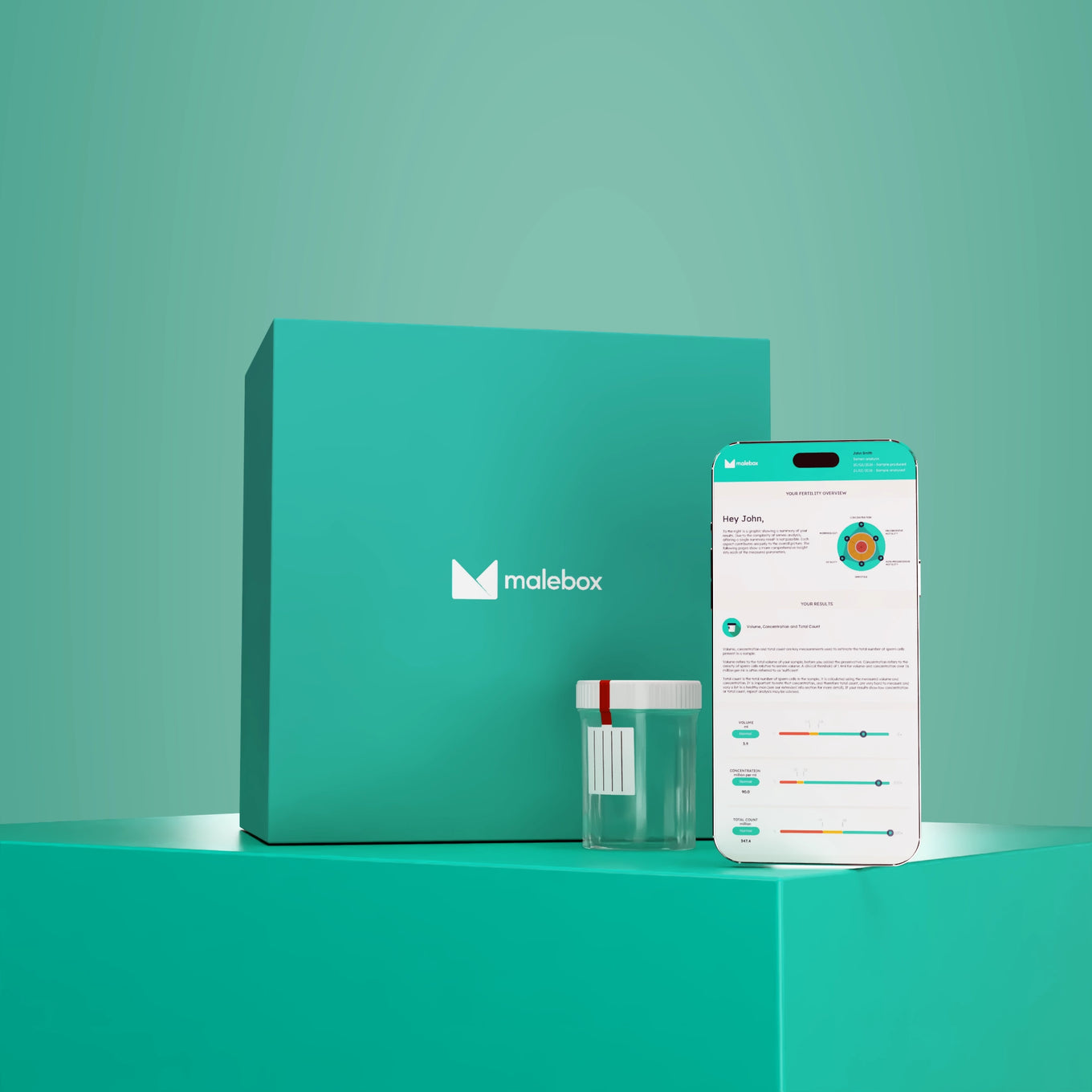
Malebox allows you to send your sperm sample to our accredited partner lab for analysis. You then have a video consultation with a fertility expert, who will walk you through your results and provide personalised advice to improve your fertility health.
This package is recommended for couples who have been trying to conceive for 12 months as per the NICE guidelines.
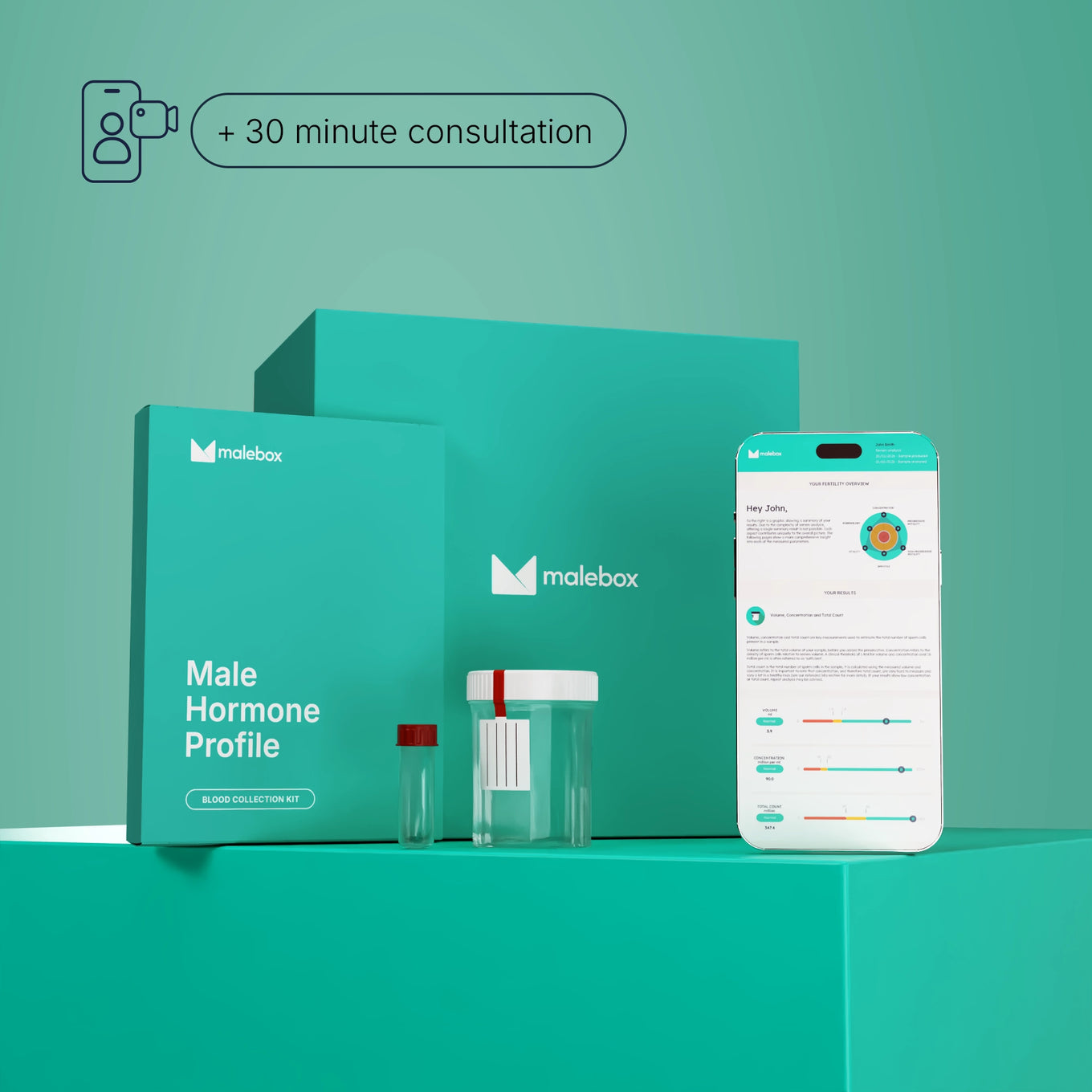
N.B. This package arrives as two separate kits. Results are delivered via video consultation once both tests are completed and analysed.
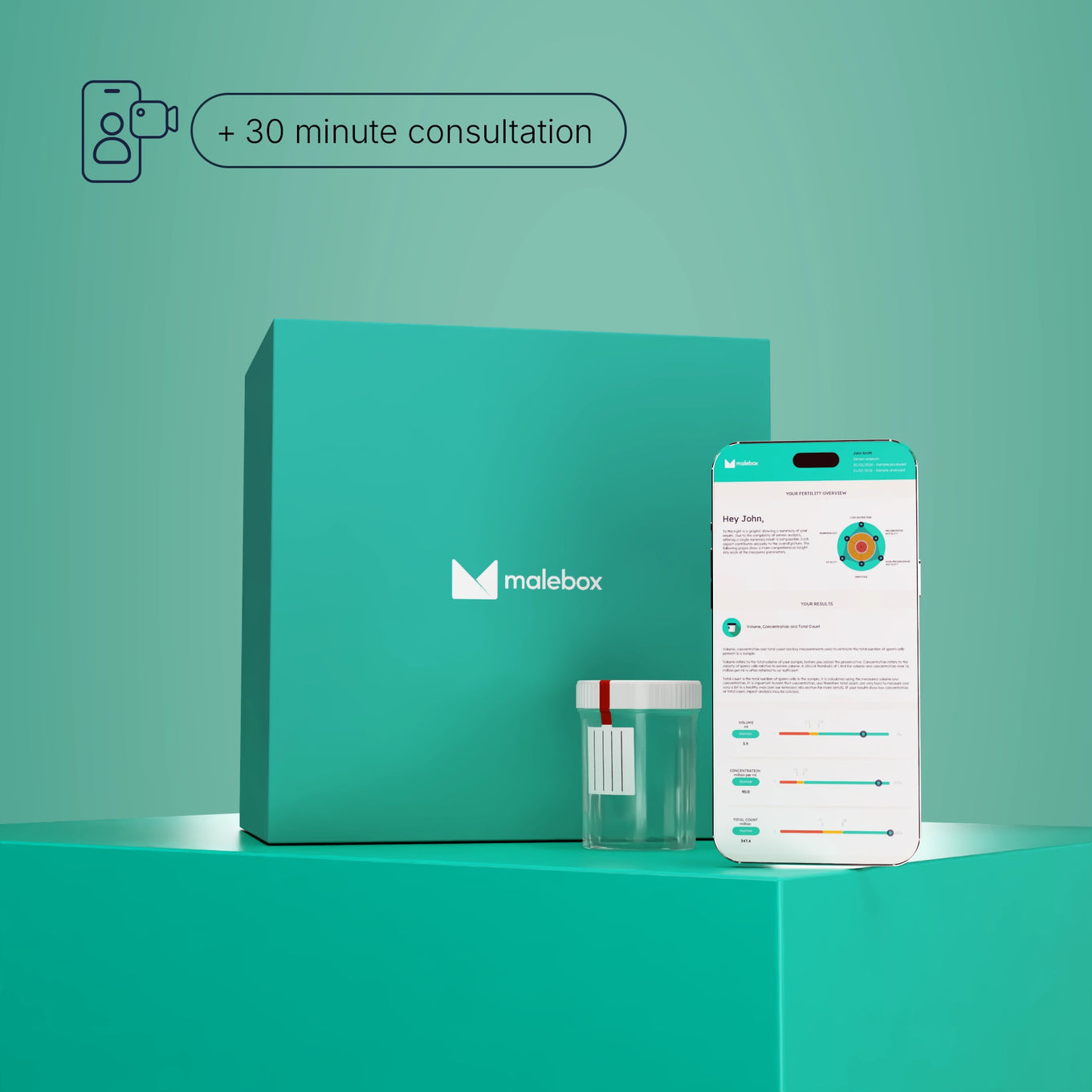
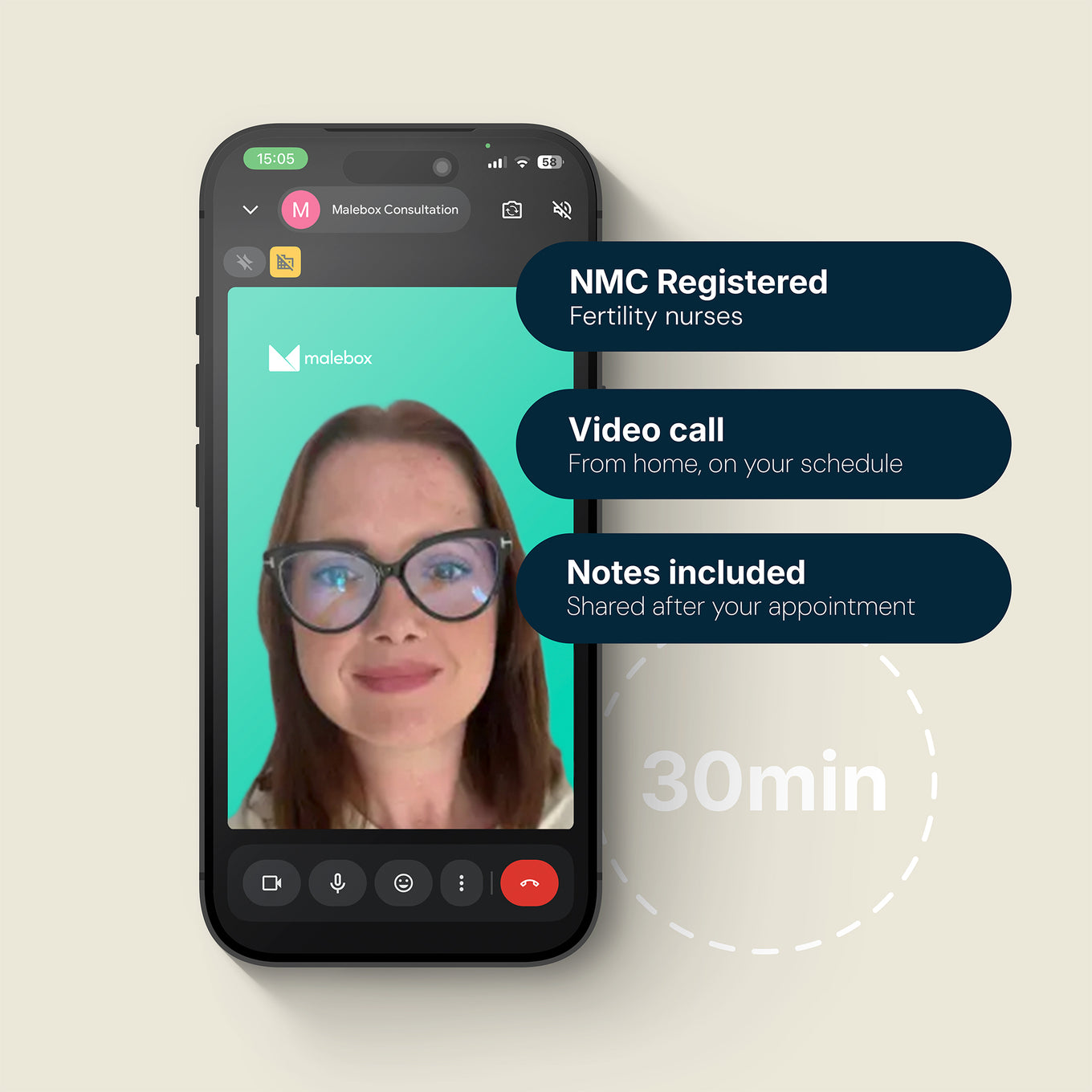
A 30-minute video call with an NMC registered fertility nurse. Get personalised guidance on your fertility health and a clear plan for next steps, from home.
Every Malebox at Home Semen Analysis Kit is analysed by a HCPC registered clinician following WHO guidelines.
Consultation with a fertility specialist
Your results will be shared via a video consultation with a fertility specialist. You'll receive tailored advice for the next steps in your fertility journey.
A report you can understand
After your consultation, you'll receive a clear, comprehensive fertility report covering the parameters of your semen analysis. It's easy to understand, no medical background needed.
Sperm Testing, made simple
Easy-To-Read Semen Analysis Report
Your Malebox report breaks down the parameters of your semen analysis - volume, concentration, motility, morphology and more - with each result compared against WHO reference ranges. It's designed to be understood without a medical degree, so you're never left wondering what it means for you.
youtube
Why Choose Malebox?
Understand Your [img1] From [img2]With Expert [img3]
A guide to understanding fertility potential, sperm preservation, and the Malebox Health services available to LGBTQ+ people planning their futures.
Fertility health is health. Whoever you are, whatever your path looks like, understanding your reproductive options is a step worth taking early, long before you need the answers.
Pride Month is a moment to celebrate visibility and community. It is also a meaningful time to talk about something that often gets left out of LGBTQ+ health conversations: family building, and the practical steps you can take today to protect your options for tomorrow.
The routes into parenthood are as varied as the people taking them. For gay men navigating surrogacy or co-parenting, knowing the quality of your sperm matters from the outset. For lesbian couples working with a known sperm donor, having clinical confirmation of that donor's fertility health gives everyone clearer ground to stand on. For trans and non-binary people with testes, sperm testing and preservation can be a meaningful step before gender-affirming care changes the picture.
These are not niche concerns. They are practical health questions, and they are exactly the kind of questions Malebox Health is built to help with.
Why fertility awareness matters for LGBTQ+ family planning
There are many ways to build a family. Adoption, surrogacy, co-parenting, reciprocal IVF, fostering, donor conception: the paths are genuinely varied, and no single route suits everyone. But for anyone who may want to use their own genetic material, or who is relying on someone else's, understanding sperm health gives you options, confidence, and information that matters.
Sperm health is rarely talked about until there is a problem. That is true for straight couples and it is even more true in LGBTQ+ contexts, where the conversation around fertility tends to focus on logistics rather than biology. But the biology still matters, and getting ahead of it is always better than finding out too late.
Worth knowing
According to the Human Fertilisation and Embryology Authority (HFEA), around one in six couples in the UK experience difficulty conceiving. In around half of those cases, sperm health is a contributing factor. Understanding sperm quality early, regardless of how you plan to conceive, gives you more options and more time.
For gay men: understanding your fertility health before surrogacy or co-parenting
For gay men planning to become parents through surrogacy or co-parenting arrangements, sperm quality is one of the first practical questions a fertility clinic or known surrogate will ask about. Starting that process with a clear, clinical picture of your sperm health puts you in a much stronger position.
This is true whether you are at the early thinking stage or actively moving forward with a surrogacy agency or fertility clinic. A semen analysis gives you a baseline: what your sperm count, motility, and morphology look like right now, assessed against World Health Organisation (WHO) reference ranges by HCPC (Health and Care Professions Council) registered clinicians.
Why test before you need to
Many gay men only encounter sperm testing when they are already in a fertility clinic process, often after significant time and money has already been committed. Testing earlier, on your own terms, gives you time to act on anything unexpected without the pressure of a clinical timeline.
It also means you go into any surrogacy or co-parenting conversation with real data rather than assumptions. If both partners are contributing sperm for the same surrogacy cycle, understanding both profiles gives you and your clinical team more to work with.
If both partners want to test
Malebox Health tests are individual, so each partner would order their own kit. Both can book consultations, and the results can inform a joint conversation with a fertility nurse about your options. There is no clinical reason to delay this, and good reasons to do it early.
The Malebox Home Sperm Test with Consultation gives you a comprehensive semen analysis with next-day results, followed by a video consultation with an NMC (Nursing and Midwifery Council) registered fertility practitioner. If there are questions about hormone levels as well, the Sperm Test and Hormone Profile adds a full male hormone panel to the picture.
Surrogacy and co-parenting journeys involve a lot of moving parts. Your fertility health does not have to be one of the unknowns.
For same-sex female couples using a known sperm donor: why clinical testing matters
Using a known donor, whether a friend, family member of a partner, or someone you have met through a co-parenting arrangement, is a deeply personal choice. It comes with real advantages: you know who the donor is, you can build a relationship that works for your family, and you have a level of openness that anonymous donation does not offer.
It also comes with questions that are worth answering before you go further. Chief among them: is the donor's sperm actually viable?
What clinical testing adds to the picture
A friendly conversation and a willingness to help are not the same as confirmed fertility. Sperm health varies enormously between individuals, and there is no reliable way to know without testing. Factors including count, motility, and morphology can all affect whether a home insemination or clinical procedure is likely to succeed.
Getting a Malebox test done before you begin gives everyone involved clearer information and more realistic expectations. It also means that if there is something to address, you find out before you have invested emotionally and practically in a process that may not work.
A practical step for known donors
A known donor taking a Malebox Home Sperm Test gets a full semen analysis assessed by HCPC registered clinicians, with results delivered in a video consultation with an NMC registered fertility nurse. The report is easy to read and designed to be shared. It is a straightforward way to give everyone involved a clear and clinically credible picture.
There are also legal and clinical considerations worth knowing. In the UK, if insemination takes place at a licensed fertility clinic, the donor's legal status and any parental rights are governed by the Human Fertilisation and Embryology Act. If home insemination is used, the legal position is different and it is important to take independent legal advice. A Malebox fertility practitioner consultation is a good place to ask clinical questions, and your nurse can point you towards appropriate next steps for any legal or clinical referrals you may need.
Reciprocal IVF
For some couples, reciprocal IVF, where one partner provides the eggs and the other carries the pregnancy, is a route that allows both partners to be directly involved in the process. This requires a fertility clinic and a sperm donor, known or anonymous. If you are using a known donor for reciprocal IVF, the clinic will require a full semen analysis as part of the donor screening process. An at-home Malebox test is not a substitute for clinic-based donor screening, but it can give your donor a clear picture of their baseline before that process begins, and flag anything that needs to be discussed with the clinic team.
For trans and non-binary people: understanding and preserving your fertility options
For trans and non-binary people with testes, fertility conversations often feel like they are happening in a separate world from the rest of gender-affirming care. They should not be. Sperm health and preservation are practical health decisions that fit naturally alongside any other steps you are taking, and the earlier they happen, the more options remain available.
Before starting hormone therapy
Oestrogen-based hormone therapy, commonly part of feminising gender-affirming care, can significantly reduce sperm production. In many cases this reduction is reversible if hormone therapy is stopped, but this is not guaranteed, and the timeline for recovery varies considerably between individuals. Preserving sperm before starting hormone therapy means you retain options regardless of how your body responds.
Before gender-affirming surgery
Some surgical procedures, including orchiectomy (removal of the testes), permanently end the possibility of producing sperm. Preservation before surgery is the only way to retain the option of using your own genetic material in future.
The timing question
The right time to test and preserve is before starting any treatment that may affect fertility, not after. Once hormone therapy begins, sperm quality and quantity can change quickly. A test ahead of starting treatment gives you the most accurate baseline and the widest range of options.
The HFEA recommends that anyone considering hormone therapy or gender-affirming surgery who may wish to have biological children in the future should discuss fertility preservation before starting treatment. This guidance exists because some effects on fertility may be irreversible. If this conversation has not been raised by your care team, it is entirely reasonable to raise it yourself.
What a Malebox sperm test actually tells you
A semen analysis measures the key markers of sperm health that clinicians use to assess fertility potential. These are the same markers used by the WHO to define normal sperm parameters, and the same ones a fertility clinic would look at. If you want a fuller picture of how testing works from start to finish, our guide to at-home sperm testing in the UK walks through the whole process.
What is measured
Sperm concentration: the number of sperm present per millilitre of semen.
Total motility: the percentage of sperm that are moving, and how well they move.
Progressive motility: the percentage swimming purposefully forward, the movement that matters most for conception.
Morphology: the proportion of sperm with a normal size and shape.
Total sperm count and volume: the overall picture of what is in a sample.
Results are not just numbers on a page. They are delivered via a video consultation with an NMC registered fertility practitioner with experience in fertility clinics and the male fertility space, who can walk you through what the results mean in plain language and discuss your next steps. The report is designed to be understood without a medical degree.
How Malebox Health can help
Malebox Health offers at-home sperm testing that removes the barriers that can make this step feel difficult: no clinical waiting rooms, no referral requirements, results and consultation delivered to you wherever you are. If you are wondering what the experience involves, here is what you can expect from a fertility test.
Both of our products, the Home Sperm Test with Consultation and the Home Sperm Test & Male Hormone Profile, are suitable for anyone with testes who wants to understand their sperm health, regardless of gender identity or sexual orientation. If you are a known donor, a gay man planning for surrogacy, a trans or non-binary person considering preservation, or simply someone who wants to know where they stand, these tests are designed for you.
Accessing care that feels right for you
We know that healthcare settings have not always been affirming spaces for LGBTQ+ people. From language that does not reflect your identity to clinicians who lack experience in the realities of diverse family building, the barriers to accessing reproductive health support are real.
At Malebox Health, we are committed to providing care that is respectful, clear, and free from assumption. Our fertility practitioners are experienced in supporting a range of clients through reproductive health conversations. If you have questions about how we approach identity and language in our consultations, please reach out before booking.
A note on language
Malebox Health uses the language in this article with the intention of being accurate and inclusive. We recognise that the language around gender, sexuality, and reproduction is evolving, and we are committed to listening and updating how we communicate. If anything here does not sit right with you, we welcome that feedback.
You do not have to have all the answers right now
Family building decisions are deeply personal, and there is no timeline you are supposed to be on. But information is rarely a bad thing to have early. Understanding sperm health now, before other decisions narrow your options, gives you the freedom to make choices that are genuinely yours.
That is what this is really about: not pressure to make any particular decision, but access to the information that makes real choice possible.
Fertility health should not be a source of stress or embarrassment. Whatever your path to family looks like, you deserve to walk it with clear information and clinical support that treats you with respect.
Frequently asked questions
Can a known sperm donor use an at-home sperm test?
Yes. A known donor can take a Malebox Home Sperm Test and receive a full semen analysis, assessed by HCPC registered clinicians against WHO reference ranges, with results explained in a video consultation. The report is designed to be shared. For licensed clinic treatment, formal donor screening is still required.
Should I preserve sperm before starting hormone therapy?
The HFEA recommends discussing fertility preservation before starting hormone therapy or having gender-affirming surgery if you may want biological children in future. Oestrogen-based hormone therapy can significantly reduce sperm production, and recovery is not guaranteed. Testing and preserving before treatment keeps the widest range of options open.
What does a sperm test measure?
A semen analysis measures sperm concentration, total and progressive motility, morphology, total sperm count, and semen volume, assessed against World Health Organisation reference ranges. Together these markers give a clinical picture of fertility potential, the same one a fertility clinic would use.
Do gay men need a sperm test before surrogacy?
Sperm quality is one of the first things a fertility clinic or surrogacy agency will ask about. Testing early gives you a clinical baseline and time to act on anything unexpected, before significant time and money are committed. If both partners may contribute sperm, each can test individually.
Sources and further reading
Human Fertilisation and Embryology Authority (HFEA), Fertility preservation and Donor conception: the legal position.
NHS, Gender incongruence: clinical guidance for healthcare professionals.
World Health Organisation, WHO Laboratory Manual for the Examination and Processing of Human Semen, 6th edition.
National Institute for Health and Care Excellence (NICE), Fertility: assessment and treatment for people with fertility problems, CG156.
Human Fertilisation and Embryology Act 1990 (as amended).
Malebox Health does not provide medical or legal advice. This article is for informational purposes only. If you have questions about your fertility health, gender-affirming care, or the legal aspects of donor conception, please speak with a qualified healthcare or legal professional.
Sperm quality changes with age, but it's a topic that rarely gets the attention it deserves. In this guest post from The Ribbon Box, the team breaks down exactly what happens to sperm parameters from your mid-30s onwards, miscarriage risk, and what the research says about lifestyle changes that can actually move the needle. With insight from Malebox, it's a practical, evidence-backed read for anyone thinking about conception now or in the future.
Male fertility is talked about far less than it should be, yet it accounts for around half of all fertility challenges. In this guest post from The Ribbon Box, fertility writer and TTC veteran Jessie Day breaks down everything you need to know about at-home sperm testing: what makes some kits more reliable than others, how to collect a sample correctly, and why a clinical consultation matters as much as the result itself.
An at-home sperm test lets you check your sperm health from home, with lab analysis and a clinician to explain the results. Here is how it works, what each number means, and what separates a reliable kit from a basic one.
Heat does affect sperm. Hot weather, saunas and regular hot baths all raise scrotal temperature, which can reduce sperm concentration, motility and count. The effects are generally reversible, but knowing what to expect can help you make informed choices.
Most men have no idea what their sperm count actually is, or what the numbers on a semen analysis report even mean. There is no single magic figure that defines "normal", and the benchmark used by UK fertility labs is more nuanced than a pass or fail. This guide breaks down the four key parameters measured in a semen analysis, the WHO 6th edition reference values currently used across the UK, and what a result above or below those values actually tells you, so you can read your results with confidence rather than confusion.